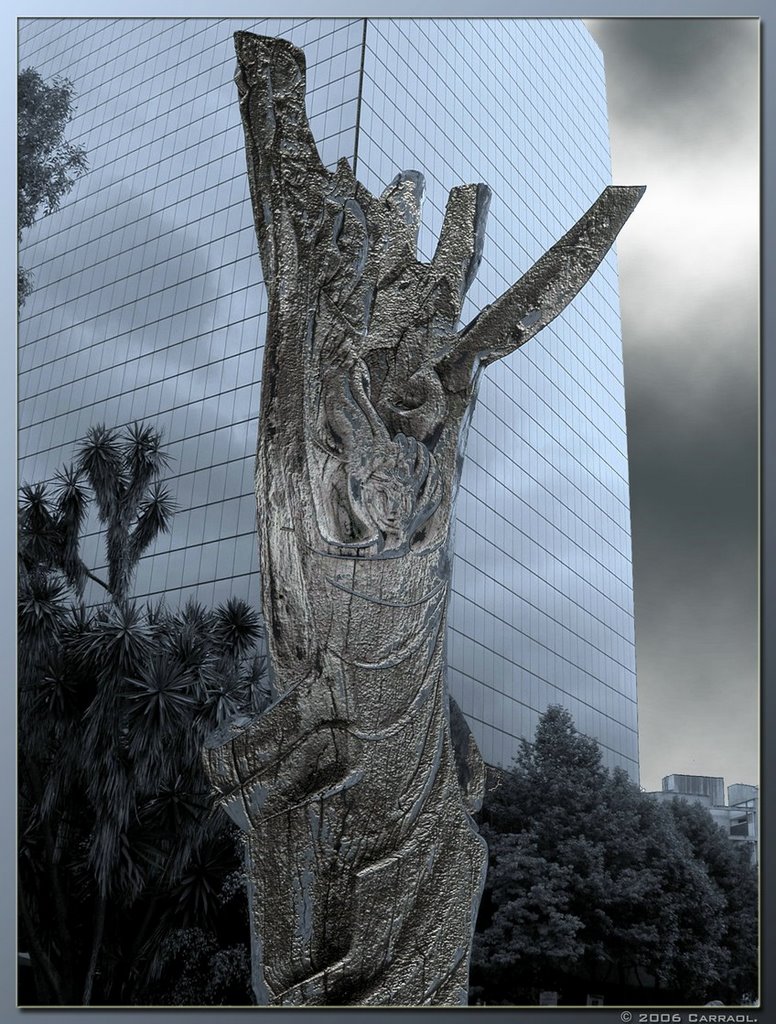
Tarde lluviosa en Bosque de las Lomas [ Stormy afternoon at Bosque de las Lomas ]

Tarde lluviosa en Bosque de las Lomas [ Stormy afternoon at Bosque de las Lomas ]


Teotihuacán is one of the major tourist attractions in Mexico City – a place that’s full of attractions. I urge you to go. It’s easy to get to. There are decent eating places out there and lots to see and do. There’s a museum and a cultural center and plenty of places to buy souvenirs. And if you’re feeling energetic, try the climb up to the top of either pyramid. At the very summit of the Pyramid of the Sun there’s a metal spike sticking up an inch or so out of the stone. Do what everyone did when we were up there - hold on to it and let the Pyramid’s energy flow into your body.
If you go with an experienced guide, one who knows his or her stuff, there’s lots to learn and see and think about. But if you just want to visit and take in the ambiance of one of the world’s great archaeological sites, then Teotihuacan is still enjoyable and rewarding.
Alan Cogan.

Teotihuacan arose as a new religious center in the Mexican Highland, around the time of Christ. Although its incipient period (the first two centuries B.C.) is poorly understood, archaeological data show that the next two centuries (Tzacualli to Miccaotli phases; A.D. 1-200) were characterized by monumental construction, during which Teotihuacan quickly became the largest and most populous urban center in the New World. By this time, the city already appears to have expanded to approximately 20 square km, with about 60,000 to 80,000 inhabitants (Millon 1981:221). The development of the city seems to have involved inter-site population movements, exploitation of natural resources, an increase in agricultural production, technological inventions, establishment of trading systems and other kinds of socio-political organizations, and attractive belief systems. By the fourth century, unmistakable influences of Teotihuacan were felt throughout most parts of Mesoamerica. Teotihuacan was the sixth largest city in the world during its period of greatest prosperity, according to an estimated population of 125,000 (Millon 1993:33). The city seems to have functioned for centuries as a well-developed urban center until its rather sudden collapse, possibly in the seventh century. The place was called Teotihuacan by Nahuatl speakers several centuries after the city's fall, but its original name, the language or languages spoken there, and the ethnic groups who built the city are still unknown.
Saburo Sugiyama: Arizona State University, Dept. of Anthropology, Tempe, AZ 85287 ©Copyright 1996 Project Temple of Quetzalcoatl, Instituto Nacional de Antropología e Historia, Mexico/ ASU

This girl sells almost everything, mainly fast food, cigars, sodas, bottled water, etc.

Words (author unknown). In the background, The Popocatpetl volcano
¿Acaso es verdad que se vive en la Tierra?
¿Acaso para siempre en la Tierra?
¡Sólo un breve instante aquí!

Thanks for the tip to enlarge the photos to: Dsole, Arradon, Ming
If you want to post the larger format:
1-Upload a photo as you usuall do.
2-Then click on the "edit HTML" icon.
3-You will see something that starts like this: src="http://4.bp.blogspot.com/.../s400
4-Change s400 to s640.
Then, open Template:
1-Go down to "Header". Change "width:660px;" to "width:880px;"
2-Go down to "Content". Change "width:660px;" to "width:880px;"
3-Go down to "Sidebar". Change "width:220px;" to "width:180px;"
4-Try with "preview" to see if it's ok.

An old woman begging for money to eat, sit on the stairs of a church and the curiosity of the little girl.

Metrobus and light traffic in Insurgentes Ave., this street one of the longest of the world, crosses the city North to South or viceversa. (El Metrobus y algo de trafico en Av. Insurgentes, una de las mas grandes del mundo, atraviesa la ciudad casi en su totalidad de Norte a Sur o viceversa).

Friday at 0:42 AM Epicenter on Pacific coastal 155 miles of Mexico City (En la madrugada del viernes a las 0:42 Hrs. con epicentro en la costa del Pacifico, a 155 millas de la ciudad) No damage, just the scare.

Work by Mexican architect, Agustin Hernandez.
La imaginacion produce formas y cosas desconocidas. El Poeta diseña y da nombre y habitacion a cosas que parecen surgir de la nada.
W. Shakespeare

Sunday flea market, where you can get paintings, movies, music, antiques and all sort of things


Two works by the greatest surrealistic painter & sculptor, Leonora Carrington: Crocodile Fountain and the bench "There's no place anymore" [Ya no hay lugar].

Santa Fe a new devolepment in the western hills of the city, a growing boom of construction in this area, like this isolated buildings.

Paseo de la Reforma, the main street and in the background, the Diana Fountain & the tallest building in the city, "La Torre Mayor"

Jacaranda is a genus of 49 species of flowering plants in the family Bignoniaceae, native to tropical and subtropical regions of South and Central America, Mexico, and the Caribbean. The genus name is also used as the common name. [Wikipedia] The city is full of this beautiful tree.

Don Antonio de Bucareli y Ursúa el 20 de marzo de 1779 siendo el nuevo virrey de la Nueva España, mandó construir e inaugurar una fuente en la cual terminaban los arcos de un acueducto por donde corría el tan necesitado líquido, que iba desde los manantiales del cerro del Chapulin (Chapultepec); este acueducto recorría lo que es actualmente la Avenida Chapultepec y Arcos de Belén.
Salto del Agua fountain, placed nearby in 1779 by Viceroy Don Antonio de Bucareli y Ursúa. This fountain is one of the remains of a large acueduct that existed in the colonial era and ran from Chapultepec Park to Salto del Agua. Today are some ruins about the acueduct in Avenida Chapultepec near Metro Sevilla. The fountain has a sculpture of three children riding dolphins. (Wiki)

"Banca Reflejo" de Alberto Parodi, de la exhibicion en Paseo de la Reforma, Dialogo de Bancas. 'Reflection Bench' by Alberto Parodi, from the exhibition, Benches Dialogue at main street of the city.